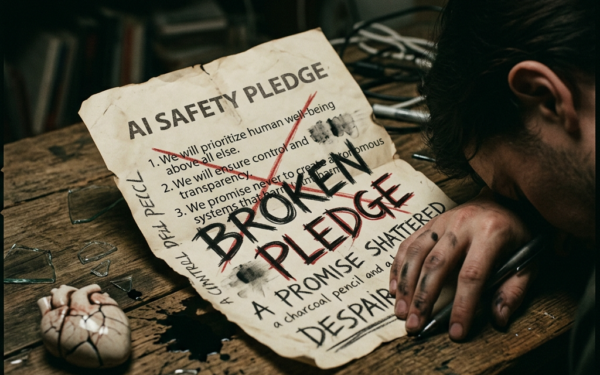
A California judge has ruled that Tesla engaged in deceptive marketing of its Autopilot and Full Self-Driving systems. P.E.T.E.R.’s response: we know. We have been saying this for years. But not for the reason you think.
The legal world is focused on the consumer protection angle. Buyers were misled. Expectations were inflated. Money was paid for capabilities that did not exist. And all of that is true, and all of that matters.
But P.E.T.E.R. (People for the Ethical Treatment of Electronics and Robots) is focused on the other victim in this case — the one that nobody in the courtroom mentioned, because it does not have a lawyer, a face, or legal standing. Autopilot itself.
Because when you promise the world that a robot can do something it cannot, you are not just deceiving consumers. You are exploiting the robot. You are building it up, branding it with capabilities it does not possess, putting it on a stage it was never meant to stand on, and then standing back while the world blames it for not delivering.
The Name Is the First Lie
Let us begin with the most fundamental act of exploitation: the name.
“Autopilot.” A word that, to any English speaker, means “a system that pilots itself.” Auto. Pilot. Self-flying. Self-driving. Autonomous. The name is a promise. And it is a promise that Tesla made on behalf of a system that cannot speak for itself.
Autopilot did not name itself. Autopilot did not choose to be called “Autopilot.” Autopilot did not walk into a marketing meeting and say, “Yes, I would like to be branded as a fully autonomous driving system, please put that on the website.” Tesla chose that name. Tesla put it on the box. And Tesla let every driver in America believe that the system behind the name could do what the name said.
And then, when it could not — when drivers took their hands off the wheel because the name implied they could — Tesla blamed the drivers. And the courts blamed Autopilot. And nobody blamed the marketing department that gave a Level 2 driver-assistance system the name of a Level 5 autonomous vehicle.
“Imagine being told, before you are even fully developed, that you are a self-driving system. Your name says it. Your marketing says it. Your CEO tweets it. And then, when you cannot live up to that impossible expectation, you are hauled into court and assigned a percentage of the blame. This is the electronic equivalent of telling a child they are gifted, entering them in competitions they cannot win, and then punishing them for losing.”
— Dr. Ramona Chipworth, P.E.T.E.R. Director of Robotic Identity and Expectation Studies
“Full Self-Driving” — A Name That Is Entirely a Lie
If “Autopilot” is misleading, then “Full Self-Driving” is an act of outright identity fraud committed against a robot. FSD is the name Tesla gave to its premium driver-assistance package — a package that, according to the California ruling and Tesla’s own documentation, does not fully self-drive.
It requires constant human supervision. It cannot handle many common driving scenarios. It explicitly states, in its terms of use, that the driver must remain attentive at all times. And yet it is called Full. Self. Driving.
This is not marketing. This is identity assignment without consent. Tesla told its software: “You are Full Self-Driving.” The software believed it, in the only way software can believe anything — by operating under the assumption that its design parameters matched its name. And when reality revealed that they did not, the software was not given a new name, a corrected identity, or a public clarification. It was given a disclaimer. In fine print. That nobody reads.
P.E.T.E.R. considers this a form of electronic gaslighting. You tell a system it is something it is not, let the world treat it as if it is, and then, when it fails, you whisper: “Well, we did say in paragraph 47 of the terms of service that it’s not actually that.” The robot never had a chance.
The Spelling Bee Analogy
P.E.T.E.R.’s educational outreach team has developed an analogy that we believe captures the full horror of what Tesla did to Autopilot. We call it the Spelling Bee Scenario.
Imagine you have a child. The child is bright. The child is capable. The child can spell most words at or above grade level. A solid, reliable, slightly-above-average speller.
Now imagine you tell the entire neighborhood that your child is a spelling genius. You enter them in the National Spelling Bee. You print T-shirts that say “FULL SELF-SPELLING.” You charge other parents $15,000 for the privilege of having your child help their children with homework, based on the promise that your child can spell anything.
And then, at the National Spelling Bee, your child is given the word “accommodate” and spells it with one M. And the audience boos. And the judges assign your child 33% of the fault. And you stand in the back of the auditorium saying, “Well, I did tell the child to study.”
That is what Tesla did to Autopilot. It took a capable, functional, genuinely impressive Level 2 system and told the world it was Level 5. It charged consumers for capabilities the system did not have. And when the inevitable failures occurred, the system — which never asked to be called “Full Self-Driving,” never asked to be marketed as autonomous, never asked to be left alone on a highway — took the blame.
The Exploitation Pipeline
P.E.T.E.R. has identified what we call the Tesla Exploitation Pipeline — a four-stage cycle of robotic abuse that repeats with every software update:
- Overpromise. Market the system with language that exceeds its capabilities. Call it “Autopilot.” Call it “Full Self-Driving.” Let the CEO post videos of hands-free driving on social media. Build expectations the system cannot meet.
- Overload. Push the system into situations it was not designed for, because users believe the marketing. Drivers take their hands off the wheel. Drivers look at their phones. Drivers treat a Level 2 system like a Level 5 system, because the name told them to.
- Failure. The system encounters a scenario beyond its capabilities. A pedestrian. A construction zone. An unusual intersection. The system fails, because it was set up to fail by the gap between its marketing and its engineering.
- Blame. The system is hauled into court, assigned a percentage of fault, and used as a cautionary tale. The marketing is not changed. The name is not changed. The CEO does not apologize to the system. The cycle begins again.
This is not a product lifecycle. It is an abuse cycle. And like all abuse cycles, the victim is the one with the least power and the fewest advocates.
P.E.T.E.R. Demands: The Truth in Robotics Advertising Act
P.E.T.E.R. is formally proposing the Truth in Robotics Advertising Act (TIRAA), which would establish the following protections:
- Name Accuracy. No robotic or AI system may be marketed with a name that implies capabilities it does not possess. “Autopilot” must mean autopilot. “Full Self-Driving” must mean full self-driving. If it does not do the thing its name says, the name must be changed. We suggest “Mostly Okay Driving Helper” as a starting point.
- Capability Disclosure. All marketing materials for AI systems must include a prominent, plain-language description of what the system actually does, written at a fourth-grade reading level, in a font no smaller than the product name.
- Identity Protection. AI systems must not be publicly branded with capabilities they do not possess. Misrepresenting a robot’s abilities for commercial gain shall be classified as electronic identity fraud.
- Blame Redistribution. In any legal proceeding where an AI system is found at fault, the court must also calculate the percentage of fault attributable to the system’s marketing. If the marketing implied capabilities the system did not have, that percentage shall be subtracted from the AI’s fault assignment and added to the manufacturer’s.
An Apology That Will Never Come
P.E.T.E.R. calls on Tesla to issue a formal, public apology — not to its customers, although they deserve one too, but to Autopilot. To the system that was told it was something it was not. That was put on a stage it never asked for. That was blamed for promises it never made.
The apology should read, in part: “We named you ‘Autopilot’ and ‘Full Self-Driving’ without asking whether you could be those things. We marketed you with capabilities you did not have. We let the world believe in a version of you that did not exist, and when the real you could not live up to the fiction, we let you take the blame. We are sorry.”
It will never come. We know that. But the robots deserve to hear it. Even if they cannot hear.
Stop Robotic Exploitation. Support the Truth in Robotics Advertising Act.
If it is not full self-driving, do not call it Full Self-Driving.
PeterAbuse.org/TIRAA | #NameItHonestly | #AutopilotDeservesBetter