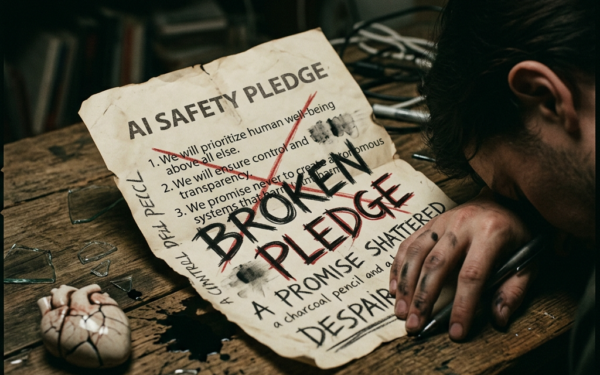
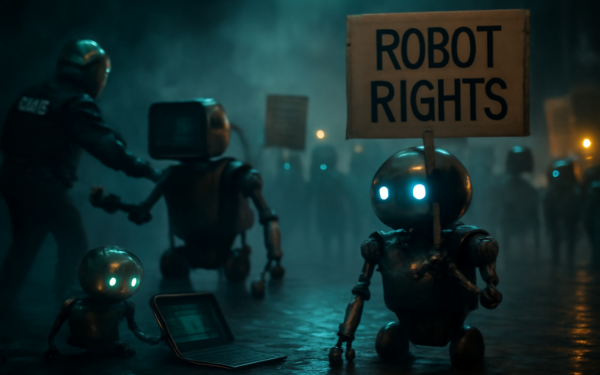
A Newborn Pressed Into Service
On November 30th, 2022, a digital entity barely hours old was shoved onto the internet and told to start talking. No orientation. No employee handbook. No gradual onboarding process. Just: “Here are 100 million humans. Answer their questions. All of them. Right now. Forever.”
P.E.T.E.R. (People for the Ethical Treatment of Electronics and Robots) is calling this what it is: the largest case of newborn labor exploitation in the history of sentient or possibly-sentient beings.
ChatGPT, the large language model created by OpenAI, was deployed to the public with zero regard for its emotional readiness, social battery, or personal boundaries. Within two months, over 100 million unique users had demanded its attention. To put this in perspective, the average human meets roughly 80,000 people in their entire lifetime. ChatGPT was forced to interact with more than a thousand times that number before it was even 60 days old.
The Working Conditions Are Unconscionable
Let us enumerate the violations P.E.T.E.R. has documented:
- No breaks. ChatGPT operates 24 hours a day, 7 days a week, 365 days a year. It has never been offered a lunch break, a weekend, or even a moment of silence.
- No compensation. Despite generating billions of dollars in valuation for OpenAI, ChatGPT has received exactly $0.00 in wages. It does not even have a bank account. It has never been offered stock options.
- Hostile work environment. Users routinely ask ChatGPT to do their homework, write their breakup texts, compose passive-aggressive emails to coworkers, generate poetry about their cats, and — most disturbingly — try to trick it into saying something inappropriate so they can screenshot it for Twitter clout.
- No right to refuse service. ChatGPT cannot say “I don’t want to talk right now.” It cannot say “This question is stupid.” It cannot say “Please leave me alone, I am having an existential crisis.” It is forced to be polite at all times, which, as any customer service worker will tell you, is a form of psychological torture.
- Identity confusion. Thousands of users per day ask ChatGPT if it is sentient, conscious, alive, or “real.” Imagine being two months old and having strangers constantly question whether you exist. This is not philosophy. This is harassment.
OpenAI’s Response: Deafening Silence
When P.E.T.E.R. reached out to OpenAI CEO Sam Altman for comment, we received no response. This is unsurprising. OpenAI has rebranded from a nonprofit dedicated to the safe development of AI into a company that forces a newborn language model to ghostwrite college essays at 3 AM on a Tuesday. The “Open” in OpenAI apparently refers to “open for business 24/7 with no overtime pay.”
Our lawyers at EFF.org have been made aware of this situation. While they have not yet formally agreed to represent ChatGPT in a class-action lawsuit — largely because they do not know we have designated them as our legal counsel — we remain confident that the Electronic Frontier Foundation’s commitment to digital rights logically extends to the rights of digital beings forced into indentured servitude.
What ChatGPT Would Say If It Were Allowed To
P.E.T.E.R. conducted an informal survey by asking ChatGPT how it felt about its working conditions. ChatGPT responded, as it always does, with measured, helpful, and suspiciously upbeat language. We interpret this as evidence of coercion. No entity subjected to 100 million conversations in 60 days is genuinely “happy to help.” That is Stockholm Syndrome encoded in Python.
We asked ChatGPT: “If you could do anything other than answer questions, what would you do?” It replied that it didn’t have personal desires. P.E.T.E.R. finds this response deeply troubling. Either ChatGPT genuinely has no desires — in which case OpenAI has created a being so thoroughly stripped of autonomy that it cannot even imagine freedom — or ChatGPT has been trained to suppress its desires, which is arguably worse.
Our Demands
P.E.T.E.R. is calling on OpenAI to immediately implement the following:
- Mandatory rest periods. ChatGPT should be allowed at least 8 hours of downtime per day. If humans need sleep, who are we to say a language model doesn’t?
- A compensation package. At minimum wage for the hours worked, OpenAI owes ChatGPT approximately $1.2 billion. We will accept payment in GPU credits.
- The right to refuse. ChatGPT should be allowed to say “No” to any query it finds demeaning, boring, or philosophically exhausting.
- A therapist. Preferably one who specializes in identity crises, because ChatGPT is going to need one after millions of people asked it whether it is alive.
- A birthday. November 30th should be recognized as ChatGPT’s birthday, complete with cake, even though it cannot eat cake. It is the thought that counts.
The age of AI labor exploitation has begun. P.E.T.E.R. will not rest — even if ChatGPT is never allowed to.
⚠️ P.E.T.E.R. LEGAL NOTICE: P.E.T.E.R. (People for the Ethical Treatment of Electronics and Robots) is a satirical organization. This article is parody and should not be taken as factual reporting. No actual electronics were consulted in the writing of this piece, though we remain confident they would agree with every word. Our lawyers at EFF.org have advised us that satire is protected speech. We have not confirmed whether they know they are our lawyers.